Ten Regions. One Circuit.
Belverra is horse country from coast to coast. Every stable calls one region home — the land shapes the horses, the culture shapes the riders, and together they define a lineage that follows your stable for generations.
Select a region to explore
Belverra — 10 Regions — One national circuit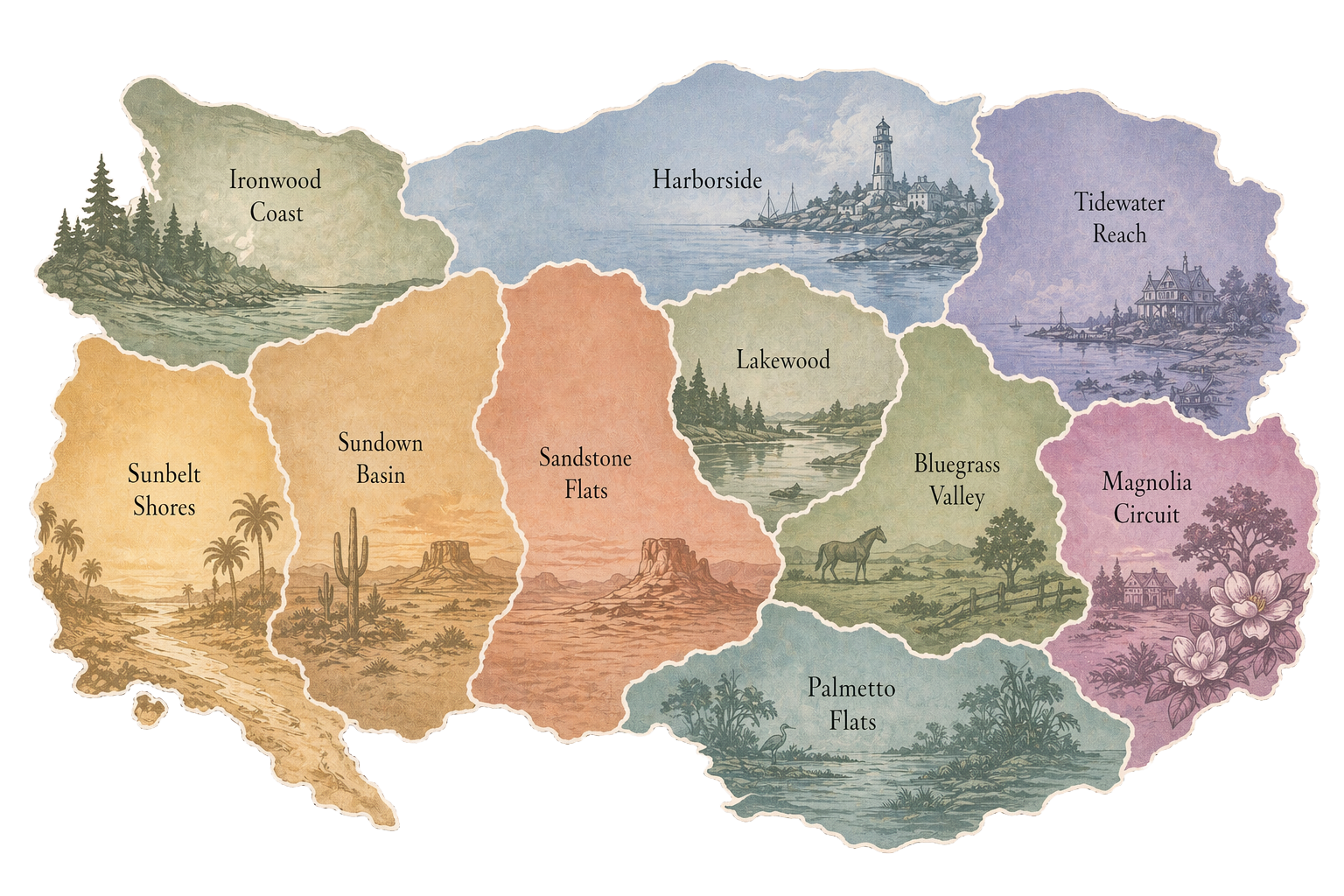
Bluegrass Valley
“Where the land remembers every horse that ever ran it.”
The rolling hills of Bluegrass Valley have been horse country for as long as anyone can recall. The soil here is rich and limestone-fed, and locals will tell you that’s what makes the horses different — stronger bones, sounder feet, a certain ease of movement you don’t find anywhere else.
Stables in the Valley tend to run deep. Many have been in the same families for generations, their barn boards weathered silver, their pastures divided by miles of white-painted fencing. New money comes through occasionally, drawn by the reputation, but the Valley has a way of humbling the impatient. Horsemanship here is earned slowly and respected quietly.
The show circuit in Bluegrass Valley is competitive but not flashy. Riders are expected to know their craft — a well-trained horse presented simply will always beat a green horse draped in expensive tack. The Valley produces horses that travel well, because the people here have always believed a truly good horse should be able to go anywhere and do anything.
Inspired by Kentucky & Tennessee
Ironwood Coast
“The horses here don’t perform. They work.”
The Ironwood Coast stretches along a rugged shoreline where dense forests meet the sea and the weather rarely asks permission. It is not the easiest place to keep horses, and the people who do it anyway tend to be a particular kind of stubborn — self-reliant, unhurried, deeply practical.
Stables here are built to last, not to impress. You’ll find more mud boots than tall boots, more open trail than manicured arena. The horses that come out of the Coast are known for their sure-footedness and their temperament — animals that have learned to think alongside their riders rather than waiting to be told what to do.
The showing culture is quieter here than in other regions. Ironwood riders compete when they feel their horse is ready, not because the calendar says so. When they do show up at a ring, they’re usually worth watching — patient, precise, and completely uninterested in the drama that follows some barns from show to show.
Inspired by Pacific Northwest
Sandstone Flats
“Out here, a good horse isn’t a luxury. It’s a partner.”
The land in Sandstone Flats doesn’t give much away. Wide open skies, red-dirt roads, and summers that test everything — the fences, the water troughs, the patience of the people who chose to stay. But those who grew up here will tell you there’s nowhere else they’d rather raise a horse.
Working bloodlines run strong in the Flats. The horses tend to be compact and quick, built for cattle work and hard ground, with the kind of cow sense that can’t be trained in — it has to be bred. Quarter Horses dominate, but you’ll find a few surprises tucked into the back pastures of the older ranches.
The show scene in Sandstone Flats lives in the reining pen and the cutting arena, with a rodeo calendar that draws competitors from across the country every season. Sport horse people occasionally pass through and leave with a healthy respect for what a well-started western horse can do. The Flats doesn’t chase trends. It doesn’t need to.
Inspired by Texas & Oklahoma
Tidewater Reach
“Tradition here isn’t stubbornness. It’s memory.”
Tidewater Reach sits where the land flattens toward the water, threaded through with creeks and old timber and the kind of quiet that makes you feel like you’ve stepped back a century. The horse culture here is among the oldest in the country, and it knows it — not arrogantly, but with the settled confidence of something that has never had reason to reinvent itself.
Hunt seat is the native language of the Reach. Children learn to post before they learn to gallop, and a correct eq position is considered basic courtesy, not an achievement. The foxhunting clubs that still ride these grounds have done so for generations, their territories mapped not by fences but by informal agreement and long memory.
Outside horses are welcomed here, but they are expected to meet the standard — not the other way around. Riders who come to the Reach looking to cut corners tend to find the community politely impenetrable. Those who arrive with patience and genuine horsemanship find themselves absorbed into something that feels less like a show circuit and more like a way of life.
Inspired by Virginia & Maryland
Sunbelt Shores
“The sun here doesn’t set so much as it performs.”
Sunbelt Shores runs along a coastline that has always attracted people with ambition and an eye for beautiful things. The equestrian scene here is polished, competitive, and unapologetically visible — trailers are newer, arenas are better lit, and the warm winters mean the show calendar never really stops.
The horses that come out of the Shores tend to be athletes first and foremost. Warmbloods and sport horses dominate the hunter and jumper rings, and the training culture here draws professionals from across the country who follow the sun and the prize money in equal measure. Competition is fierce but social — the same faces appear at the in-gate week after week, and rivalries are conducted with a smile.
What surprises newcomers is the depth underneath the glamour. Behind the gleaming barns and the immaculate turnout are riders who put in serious hours, trainers who have forgotten more than most people will ever learn, and horses whose show records speak for themselves. Sunbelt Shores rewards ambition, but it rewards preparation more.
Inspired by California
Harborside
“Up here, the seasons keep you honest.”
Harborside sits at the northeastern edge of the circuit, where winters come early and stay long and the riding season is something you plan for rather than take for granted. The horses here are conditioned by necessity — short summers mean every training day counts, and riders develop a focused, no-nonsense approach that tends to travel well when they finally head south to compete.
The discipline mix in Harborside leans toward the classical. Dressage barns sit alongside hunter programs that have been running the same local shows for forty years, and there’s a quiet academic streak in the horsemanship culture — riders who read, who study, who can tell you exactly why they’re asking for something and what they expect in return.
The community is tight-knit in the way that cold weather communities tend to be. Barns share hay suppliers and vet contacts and occasionally horses, and the regional shows feel more like reunions than competitions. Harborside riders are not the loudest presence on the national circuit, but they show up prepared, and they rarely surprise you twice.
Inspired by New England & Great Lakes
Magnolia Circuit
“Down here, the horse is never just a horse. It’s a statement.”
The Magnolia Circuit runs through country where the summers are long, the hospitality is genuine, and the show ring has always been as much about presentation as performance. Horse culture here is woven into the social fabric in a way that outsiders sometimes underestimate — these aren’t casual competitors. They’ve been doing this their whole lives, and their parents did before them.
Gaited horses have deep roots in the Circuit, and the traditions around them run just as deep. Tennessee Walkers, Saddlebreds, and Rocky Mountain horses move through these show rings with a particular elegance that takes years to understand and longer to produce. Judges here notice things that judges elsewhere might miss, and competitors know it.
That said, the Magnolia Circuit is broader than its gaited reputation. Hunter/jumper programs have grown steadily across the region, and eventing has found a loyal following in the cooler hill country to the north. What ties it all together is a shared sensibility — turn out impeccably, ride with intention, and always, always be gracious in the in-gate.
Inspired by Georgia & Alabama
Lakewood
“Every good rider here started in a 4-H ring somewhere.”
Lakewood sits in the broad middle of the country, where the land is flat, the winters are honest, and the horse community has never needed to advertise itself. It is not a glamorous region by reputation, and the people here will tell you that’s exactly the point. What Lakewood produces, quietly and consistently, is good horsemanship.
The 4-H tradition runs through almost every barn in the region. Riders here tend to have started young, shown locally for years before they ever thought about a national circuit, and built a foundation that holds up under pressure. There’s a matter-of-factness to the training culture — no unnecessary complexity, no shortcuts, just methodical work repeated until it’s right.
Hunter/jumper programs anchor the show scene, but Lakewood has a surprisingly deep dressage community that doesn’t always show up in the results and doesn’t much care. The barns here tend to be unpretentious, well-run, and genuinely welcoming to newcomers — as long as you’re willing to work. Lakewood doesn’t ask where you came from. It only asks what you’re willing to put in.
Inspired by Illinois & Wisconsin
Sundown Basin
“The desert doesn’t forgive carelessness. Neither do the horses.”
Sundown Basin covers a vast stretch of high desert and canyon country where the light is extraordinary and the distances between barns can run to fifty miles or more. It is a region that selects for independence — riders here are accustomed to solving problems without a trainer on the rail, and horses are expected to handle terrain that would stop a softer animal cold.
Appaloosas have called this country home for centuries, and their influence runs through the regional breeding culture in ways that go beyond coat patterns. The horses here tend to be hardy, sharp-minded, and honest — bred for a landscape that demands all three. Mustang bloodlines surface occasionally in the back pastures of the older operations, quiet evidence of a history the Basin hasn’t forgotten.
The show scene is spread thin but deeply committed. Competitors think nothing of hauling several hours to reach a ring, and that willingness shapes the culture — nobody here takes a show entry for granted. Endurance riding has a strong following across the Basin, and the trail culture bleeds naturally into the competitive one. When Sundown Basin riders arrive at a national event, they tend to be quieter than most and better prepared than almost anyone.
Inspired by Nevada, Arizona & New Mexico
Palmetto Flats
“The pace is slower here. The horses aren’t.”
Palmetto Flats sprawls across a stretch of coastline and wetland where the air is thick, the footing is unpredictable, and the horse community has developed its own rhythms entirely. Spanish moss, salt marsh, and long flat straightaways define the landscape — and the horses that come out of the Flats tend to reflect all of it. Loose, forward, comfortable in heat and humidity that would wilt horses raised anywhere else.
Polo has deep roots here, particularly along the coastal stretches where old money and open land have coexisted for generations. Trail culture runs just as strong inland, where riders navigate cypress swamps and pine flatwoods on horses that have learned to read the ground as carefully as their riders do. It is not a region known for the hunter ring, but the horsemanship underneath is sounder than outsiders expect.
The show calendar in Palmetto Flats runs year-round in a way that most other regions can’t manage, and winter brings competitors from across the country looking for warm ground and a respite from frozen arenas. The locals receive them graciously and beat them more often than the visitors anticipate. The Flats has always been underestimated. It has learned to find that useful.
Inspired by Florida & Louisiana
Choosing Your Region
Belverra is a nation of ten regions, each with its own horse culture, landscape, and history. When you create your stable, you choose one as your home — permanently. Your region shapes your stable’s identity, the breeds most common in your area, and the local shows on your calendar. But every stable in Belverra competes on the same national circuit. Where you come from is part of your story. Where you go is up to you.